
Pretreatment that makes the finish hold, for powder coating and e-coating
A coating is only as good as the surface under it. Great Dane cleans, blasts, and pretreats every part before it reaches a booth or a bath. Powder coating parts get an iron phosphate pretreatment. E-coating parts get an eight-stage zinc phosphate system. Both start with getting the metal genuinely clean.
 Why does surface preparation decide the quality of the finish?
The performance and durability of a coated finish depend greatly on how the surface is prepared before coating. Powder coating and e-coat both bond to whatever they are applied to. If that surface carries oil, rust, mill scale, or moisture, the coating bonds to the contaminant instead of the metal. The part looks right leaving the shop. Then it chips, blisters, or corrodes under the film in service, and it comes back as a warranty claim. Preparation is also where a finisher can quietly cut cost. Skipping a blast, shortening a wash, or coating a part that is not fully dry saves minutes and does not show up for months. We do not run that way. The Great Dane quality control team drove our rework rate from about 3% to below 1%, and most of that came from discipline at the front of the line.
What is the difference between cleaning, blasting, and pretreatment?
These three get used interchangeably, and they are not the same step. Cleaning removes what sits on the surface: oils, coolants, dust, and shop residue. Blasting is mechanical. It strips what is bonded to the surface, such as rust, mill scale, and old coatings, and it leaves a profile the coating can grip. Pretreatment is chemical. It changes the surface itself, forming a thin conversion layer that the coating bonds to and that adds corrosion protection under the film. Most parts need cleaning and pretreatment. Parts arriving rusted, scaled, or previously coated need blasting first. The order matters. Blasting after pretreatment would remove the layer you just built, so the sequence runs blast, clean, pretreat, dry, then coat. Knowing which of the three a given part actually needs is the judgment that keeps cost down without costing quality.
What has to come off a part before it can be coated?
The list is longer than most people expect. Mill oils, cutting fluids, drawing compounds, and rust preventives all have to come off. So do fingerprints and handling oils, which are enough on their own to cause a fisheye or a bare spot. Rust, mill scale, and heat scale from welding have to go, because they are loosely attached layers that take the coating with them when they let go. Weld slag and spatter have to be removed or the coating tents over them. Old paint, powder, or primer has to be stripped unless we have agreed to coat over it. Moisture has to be driven out completely, because water trapped in a seam or a pore turns to steam in the cure oven and blows a pinhole through the film. Silicone is the one to watch. Silicone sprays and mold releases migrate, resist cleaning, and cause craters. Tell us if your parts have seen any.
How does iron phosphate pretreatment work?
Iron phosphate is one of the most widely used pretreatments prior to powder coating, and it is what our powder line runs. Parts pass through a washer that cleans the metal, applies the phosphate solution, and rinses. The chemistry leaves a thin phosphate conversion layer on the surface. That layer does two jobs. It gives the powder a uniform surface to bond to, which improves adhesion. And it sits under the film as a corrosion barrier, so a scratch does not turn into rust creeping along the coating edge. Iron phosphate works on ferrous metals and on some nonferrous metals, which makes it practical for a shop running mixed substrates. It also cleans and neutralizes the surface as it goes. After the washer, parts move through a dry-off oven to remove the rinse water. A part that reaches the booth wet will show it after cure.
When do parts need sandblasting?
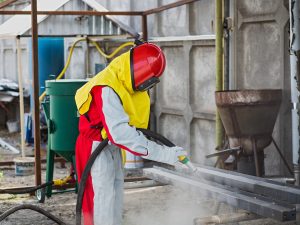
Abrasive blasting, often called sandblasting, is mechanical pretreatment. It removes rust, scale, old coatings, and surface contaminants with high-pressure abrasive media, and it is the answer when a wash will not get the surface clean. Blasting strips those layers back to sound metal. It also leaves an anchor pattern, a controlled roughness that gives the coating something to grip. On a part that will see impact or abrasion, that mechanical key matters as much as the chemistry. Blasting is not right for everything. Thin gauge sheet can distort under blast pressure. Machined surfaces, sealing faces, and bearing bores lose tolerance if they are hit, so they get masked or the part is blasted selectively. Aluminum, stainless, and soft alloys need media and pressure chosen for the substrate rather than the default steel setting. Blast residue then has to come off completely, because media dust left in a pocket becomes a defect after cure. Tell us the substrate, the gauge, and any surfaces that must not be touched.
What pretreatment do parts get before e-coating?
E-coat parts follow a different sequence in our e-coating plant. That system runs an eight-stage zinc phosphate pretreatment before the electrocoat application. The stages clean, condition, and build a crystalline zinc phosphate layer on the metal, with rinses between. Zinc phosphate builds a heavier, more corrosion-resistant layer than iron phosphate, which is part of why it is used on the e-coat side. Because e-coating is an immersion process, the pretreatment is immersion too. Every surface the solution reaches gets treated, including interior surfaces, seams, and recesses that a spray wand would miss. It also means the part has to drain. Closed tubes, boxed sections, and hollow frames need drain and vent holes so solution does not stay trapped and bleed out later across the finish. Send prints before you build the part and we will show you where the drain and vent holes need to go.
How does the substrate change the approach?
Different metals fail in different ways, so they get prepared differently. Mild steel is the straightforward case: remove oil and rust, pretreat, dry, coat. Galvanized steel needs a gentler chemistry, because an aggressive wash attacks the zinc layer you are trying to protect. Zinc also outgasses, so galvanized parts often need a lower cure or a pre-bake. Aluminum re-oxidizes within minutes of being cleaned, so the timing between prep and coating matters more than it does on steel. Stainless needs a profile more than it needs cleaning, since powder struggles to grip a smooth passive surface. Castings are the hardest case. Porous castings hold oil, moisture, and gas in the pores, and all three escape during cure and blow pinholes through the film. Those parts get a pre-bake first. Tell us the substrate and any heat treatment, and we will match the prep and the cure to it.
What do you need from us, and what if a part arrives too dirty to run?
Tell us what the parts have been through: what oils, coolants, or rust preventives they have seen, whether they have been welded, and whether they carry an existing coating. Flag any silicone exposure. Mark the surfaces that must stay bare on the print. Note any heat limits, especially on hardened parts and plated fasteners. Pack parts so they do not rub or pick up moisture in transit. If a part arrives with contamination we cannot remove with the process we quoted, or with damage or a prior coating we did not know about, we stop and call you before anything gets coated. Then we give you the options: an added blast step and a revised price, a different pretreatment, or occasionally the honest answer that the part will not hold a durable finish in its current condition. What we will not do is coat it anyway and let it fail on your equipment.
Time to Give Great Dane a Call?
That is worth asking before you ship anything. Tell us the substrate, what the parts have been exposed to, and the finish you need. We will tell you what prep the job requires and what it adds to the price and the schedule. Call 724-537-9709 or request a quote.
You can learn more about the value-added services we offer on our Custom Services page.