What Is a Mil? Why Coating Thickness Matters
By Josh Sabatini, Operations Manager, and Gary Lamolinara, Owner and General Manager, Great Dane Powder Coating
What is a mil? That’s an important question when it comes to understanding coating services. Let’s start with the basics. A mil is one thousandth of an inch (0.001″), the standard unit for measuring coating thickness. It is not a millimeter, and mixing up the two throws a specification off by a factor of nearly 40.
Thickness decides how well a finish protects a part, whether that part still fits, and how it looks coming off the line. In this article we’re going to take a look at how mils work in powder coating and e-coating, including how we measure them on our own production floor.
What Is a Mil, and How Is It Different From a Millimeter?
One mil equals 25.4 microns (µm), or 0.0254 mm. Metric drawings usually call out coating thickness in microns, while North American specifications use mils. Either works. The trouble starts when units get crossed.
We see RFQs that call out thickness in millimeters when mils were intended. A drawing that reads “3 mm” instead of “3 mils” asks for a coating about 118 mils thick, nearly 40 times what anyone wants on a part. When a number looks off, we ask before we quote.
Why Does Coating Thickness Matter?
Coating thickness controls protection, fit, and finish. Too thin, and the film can leave edges, welds, and surface peaks with too little coverage. Too thick, and threads bind, press fits fail, and assemblies stack up out of tolerance. That is why many industrial specifications set both a minimum and a maximum film thickness.
- Corrosion protection. The coating is the barrier between bare metal and moisture. When it’s too thin wear can easily expose the bare metal
- Fit and function. Coating builds on every coated surface. A bore coated at 4 mils per side loses 8 mils of diameter. Threads, bores, and press fits need precision masking or a planned film build.
- Cost and appearance. Extra film build uses more material and can leave an uneven texture, adding cost without necessarily adding more protection.
How Thick Is Powder Coating Compared to E-Coating?
Powder coating typically runs 2 to 5.5 mils, while e-coating runs much thinner, at 0.5 to 1.2 mils. The difference comes from how each is applied. Powder is sprayed on as a dry, charged powder and cured in an oven. E-coat is deposited electrically from an immersion bath, which builds a thin, even film.
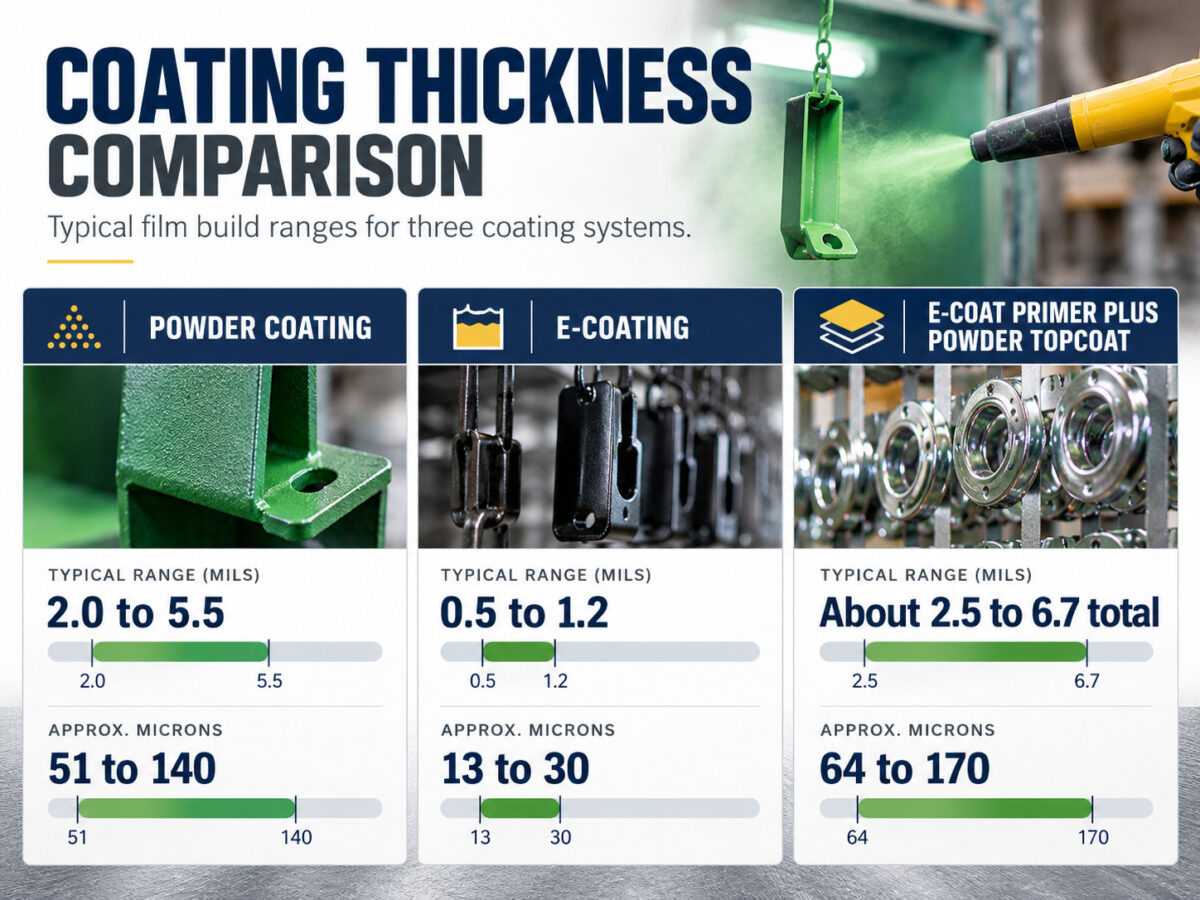
The powder coating industry treats 2 to 5.5 mils as the typical effective range, and Great Dane holds to that standard. On our e-coat line, our proprietary automatic e-coating system holds the film to 0.5 to 1.2 mils. Specs outside either range are achievable through process adjustments and added checks.
Most customers choose one process for what it does well. When a part does receive both powder coating and e-coating, the e-coat serves as a primer and the powder coating is the topcoat (each with its own mil spec). We check the e-coat after it cures, before any powder goes on, because once both layers are in place a gauge reads the combined thickness.
How Does Great Dane Measure Coating Thickness?
We measure thickness twice, both before cure and after. A non-contact uncured powder thickness gauge, known in our plant as the “pre-mil tester,” reads powder on the part before it enters the oven. A DeFelsko PosiTector 6000, our “post-cure mil tester,” reads the finished film on both powder-coated and e-coated parts.
Pre- and post-cure readings are routine throughout the production day, taken at the beginning, middle, and end of each run. For customers who need documentation, we can share results as a certificate of conformance (COC) or a detailed list of individual readings.
GD INPUT USED: Q1 (both gauges, in-house names, reading frequency, COC).
Can You Hold a Tighter Mil Spec?
Yes, but a tighter window changes the process and the price. In a shop where parts are hand-coated, powder thickness typically swings 2 to 4 mils, which is why the industry range is as wide as it is.
When an RFQ allows only a 1 to 2 mil window, our sales and quality teams talk with the customer about why the tolerance is there, what extra process steps it would take, and what those steps cost. In most cases, that conversation ends with agreement on the standard 2 to 5.5 mil range. When a tight spec truly is needed, we build the process to meet it.
A First Article Example
A “first article” is the first part, or first small set of parts, produced on a new job. Before a full production run begins, the customer inspects that first article against every requirement on the drawing or specification. This is called first article inspection, or FAI. Production moves forward only after the first article passes and the customer signs off.
For a coating job, FAI often includes film thickness, and the bar can be higher than simply landing inside a range. A customer may also want proof that the process is consistent, with every reading close to every other. That is what made the job below a real test.
A well-known name on our client list is a firearms manufacturer. They came to Great Dane to handle their very first e-coated parts. With no established mil spec, we coated sample parts at several thicknesses, and the customer ran them through its own process. That testing settled on 0.5 to 1.0 mils as the optimum coating thickness.
The range sat inside our standard, but FAI set a second bar: every reading had to fall within 0.2 mils of every other. With minor adjustments to our e-coating system, we held all readings inside that window and passed. Hitting the spec mattered to the customer. Hitting it consistently is what won us the job.
Frequently Asked Questions
Is a thicker coating always better?
No. Beyond the range a coating is designed for, extra thickness adds cost without adding useful protection, and it can interfere with fit. The right thickness is the one that meets the part’s function, environment, and tolerances.
What mil thickness should I put on my drawing?
Start with function. If a part has no fit or performance reason for a narrow window, the standard range for the process keeps cost down. If you are new to a process, sample parts coated at several thicknesses and tested in your own application are a reliable way to set the spec.
Does coating build up in threaded holes?
Yes. Coating builds on thread flanks just as it does on flat surfaces, which can keep fasteners from seating. Threads that must stay bare are masked with plugs matched to the feature, since through holes and blind holes call for different plugs.
Talk Through Your Mil Spec With Us
Whether your part calls for powder coating, e-coating, or both, we can help you set a mil spec that protects the part, fits your assembly, and makes sense on price. Send us your drawings and requirements. Call 724-537-9709 or request a quote today.