Our Process
Powder coating and e-coating, step by step, from cleaning through cure and inspection
Every part follows the same path at Great Dane: clean it, mask it, coat it, cure it, inspect it. What changes is the process in the middle. Powder coating runs on a conveyor line or in our batch system. E-coating runs by immersion in a separate plant. Here is how both work.
What happens to your parts at Great Dane?
Your parts arrive, get logged in, and get inspected before anything else happens. From there the job routes to one of two plants: our 18,000 square foot powder coating plant, or our separate 6,000 square foot e-coating plant. Every job then follows the same five stages. We clean and pretreat the metal. We mask any surface that has to stay bare. We apply the coating. We cure it. Then we inspect, unmask, and prepare the parts for shipment. Standard turnaround is five days.
How does Great Dane clean and prepare parts before coating?
Cleaning decides whether the finish holds. Coating over oil, rust, scale, or moisture produces poor adhesion, and poor adhesion becomes chipping or corrosion in the field. For powder coating, parts pass through a pretreatment washer that cleans, chemically treats, and rinses, then through a dry-off oven that drives out moisture. Parts carrying rust, scale, or an old finish get blasted first. For e-coating, parts run an eight-stage zinc phosphate pretreatment before the bath.
Our Cleaning and Surface Preparation page covers the full sequence and what we need from you.
Our Cleaning and Surface Preparation page covers the full sequence and what we need from you.
Where does masking fit into the process?
Masking happens after cleaning and before coating. It protects the surfaces that have to stay bare: threads, bearing bores, machined faces, sealing surfaces, grounding points, and hydraulic ports. If coating lands there, the part may not thread, seat, seal, or fit. We apply high-temperature tapes, silicone plugs, caps, and die-cut masks before the part enters the booth or the bath. The masking has to survive cure, then come off cleanly. Bad masking means stripping parts, re-tapping threads, or scrapping an order.
Our Precision Masking page covers the detail.
Our Precision Masking page covers the detail.
How does the powder coating line work?
Powder coating runs on two overhead conveyor lines, with parts traveling through each stage in sequence. The washer cleans, pretreats, and rinses. The dry-off oven evaporates remaining moisture. In the powder booth, an electrostatic gun charges the dry powder, and the grounded part draws it into an even layer. Our booth runs both automatic and manual application. The cure oven then melts and cross-links the powder into a hard film. Parts are unloaded, inspected, and packed.
When do parts run on the batch system?
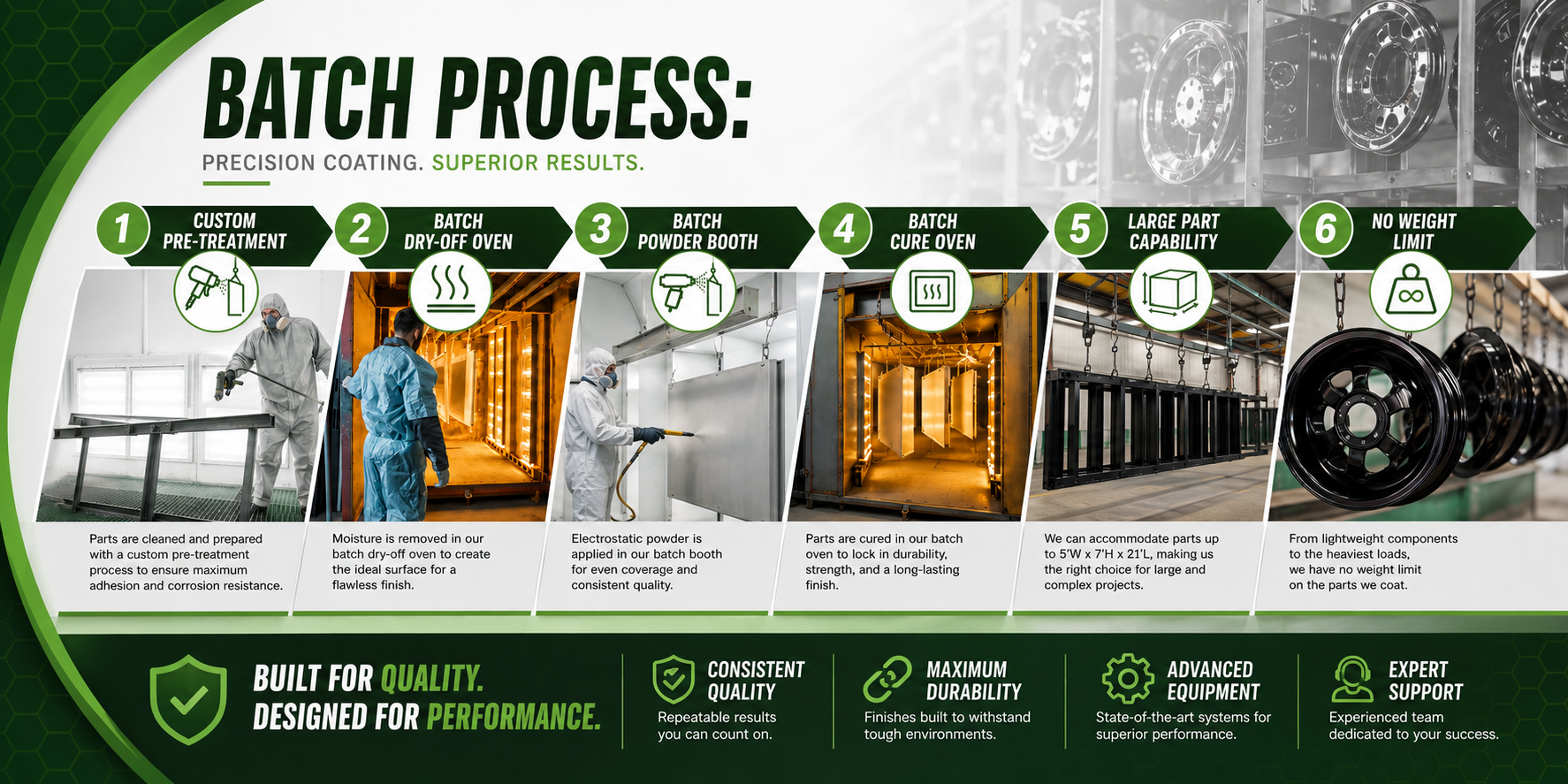
Some parts do not fit a conveyor. Long frames, tall weldments, heavy fabrications, and low-volume custom jobs run in batch instead. Batch follows the same sequence with dedicated equipment: a custom pre-treatment matched to the substrate, a batch dry-off oven, a batch powder booth, and a batch cure oven. The batch envelope accepts parts up to 5 feet wide, 7 feet high, and 21 feet long. The 300 pound conveyor limit does not apply here, since parts are racked rather than hung. Send dimensions and weight and we will confirm the fit. Both systems meet the same inspection standard.
How does the e-coating process work?
Electrocoating, or e-coat, uses electrical current to deposit paint onto a part. Because it coats even the most complex parts to specific performance requirements, it suits work where precise, uniform thickness matters. Our system runs an eight-stage zinc phosphate pretreatment followed by the electrocoat application. An automatic voltage control system works with the direct power source to deliver uniform film thickness regardless of the square footage being coated. E-coat can be used as a primer, a top coat, or both.
When do parts get a dual-layer finish?
Some parts need more protection than either process gives alone. For those we run both. E-coat goes on first as the primer, covering the whole part evenly, inside and out. Powder goes on second as the topcoat, adding hardness, impact resistance, color, and UV performance. This matters most for outdoor parts. Our e-coat bath is an epoxy primer, and epoxy primers are vulnerable to UV on their own, so a powder topcoat over e-coat is not an upsell. It is the correct answer. Both plants are ours, so the job stays on one schedule with no second vendor.
How does Great Dane control quality?
Quality control is a stage in itself, and it runs through every other stage. Parts are inspected on arrival, checked during masking, and checked again after cure. We look at coverage, color, gloss, and surface quality, and we check film thickness where the specification calls for it. Quality Manager Kendrick Bolish leads our quality systems, with a Six Sigma Green Belt and an ISO 9000 background. Plant Manager Colton Adams drove our rework rate from about 3% to below 1%. When a defect repeats, we correct the process rather than the part. After inspection we unmask, label, package, and ship.
Conveyor Specifications
- Two Overhead Conveyor Lines.
- Iron Phosphate Pre-Treatment Washer.
- Convection Dry-Off Oven.
- Automatic / Manual Powder Booth.
- Large Part Capability of 42" W x 84" H x 96" L.
- Part Weight Limit of 300 pounds.
Conveyor Process
- Parts are loaded on the conveyor line.
- Parts pass through the washer that cleans, chemically pre-treats, and rinses.
- Parts pass through the dry-off oven to evaporate moisture.
- Parts pass through the powder booth, where the powder is electrostatically applied.
- Parts pass through the cure oven.
- Parts are unloaded from the conveyor line and inspected.
- Parts are packed and ready for pickup/shipment.
Send us your part list, prints, quantities, substrate, and deadline. We will tell you which process fits, which system your parts run on, and what we need before they arrive. Call 724-537-9709 or request a quote.