
Protecting the surfaces on your part that have to stay bare
Some surfaces on your part cannot take coating. Threads, bearing bores, machined faces, sealing surfaces, and grounding points have to stay bare. Great Dane masks them before coating and removes the masking cleanly after cure. Masking is a planned, priced, inspected step here, not an afterthought at the booth.
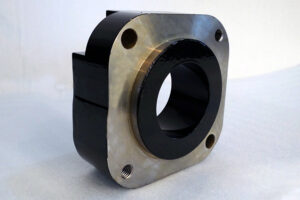 Precision Masking for Powder Coating
Intricate masking is a critical part of the powder coating process that protects specific areas of a part from receiving coating. Using high-temperature tapes, silicone plugs, custom caps, and precision masking materials, our team carefully covers threads, machined surfaces, bearing bores, grounding points, sealing surfaces, and other critical dimensions before coating begins. This ensures that powder is applied only where it is intended, maintaining tight tolerances and preserving the functionality of the finished component. Proper masking eliminates the need for costly rework, prevents assembly issues, and ensures parts fit and perform exactly as designed.
Whether a project requires a single masked feature or a complex multi-step masking process, precision masking allows us to deliver a high-quality finish while meeting the exact specifications of each customer’s application.
Masking for powder coating or e-coating is not an add-on at Great Dane. It is a planned step in the routing, priced into the job and inspected like every other stage.
Which surfaces get masked?
Threads are the most common masked feature, both tapped holes and external threads on studs and shafts. Bearing bores, bushing seats, and shaft journals come next, because a few thousandths of film changes a press fit. Machined faces, mating flanges, and gasket or O-ring sealing surfaces get masked so the joint still seals. Grounding points and electrical contact surfaces have to stay bare metal or the circuit does not complete. Dowel holes, locating pins, and tooling holes get masked so the part still indexes in your fixture. Hydraulic and pneumatic ports, fittings, and fluid passages get masked to keep coating out of the system. Part numbers, serial stamps, and data plates get masked when they have to stay legible. Wear surfaces, chain paths, and sliding contact faces are usually better left uncoated than coated and worn through. Weld prep areas get masked when the part will be welded after coating. If a feature has a tolerance on it, mark it on the print and ask.
What masking materials does Great Dane use?
The material has to survive everything the part goes through, then come off without a trace. High-temperature tapes handle flat faces, edges, flanges, and irregular areas. They hold at cure temperature and release cleanly afterward. Silicone plugs and caps handle holes, bores, studs, and ports. Silicone tolerates repeated oven cycles better than most materials and pulls out cleanly. EPDM plugs handle applications where silicone is a problem, particularly where silicone transfer could contaminate a later process. Custom caps handle shapes that a stock plug will not seal. Die-cut masks handle repeating features on a production run, where cutting tape by hand would be slow and inconsistent. Pull tabs get added so masking comes off fast and completely after cure. We choose the material by the feature, the substrate, the process, and the cure schedule. A plug that works through a powder cure may not be the right plug for an immersion bath. Getting that choice right is most of the job.
How is masking for e-coating different from masking for powder coating?
Powder is a dry material applied by spray. E-coat is a liquid, and the part is submerged in it. That single difference changes the masking. A spray gun approaches from a direction, so a mask only has to block that path. An immersion bath surrounds the part, so a mask has to seal. Any gap, any unsealed seam, any path a liquid can follow, the bath will find. Plugs have to seat positively rather than sit in the hole. Tape edges have to be burnished down rather than laid on. The bath also fills cavities, which means masking has to account for what happens when the part comes out. Trapped solution has to drain, or it bleeds out during cure and runs across the finish. Hollow sections need drain and vent holes designed in. Masking material also has to hold up through the full eight-stage pretreatment sequence in a wet, charged environment, not just through one pass at a booth. A dual-layer part gets masked twice, once for each pass.
What goes wrong when masking is done badly?
The cost of bad masking depends entirely on when it is caught. Caught in our shop, a coated thread means stripping and recoating the part, or chasing and re-tapping the thread. That costs time and it costs part life.
Caught after the parts ship, it costs more. Your team finds it at assembly, the line stops, and the parts come back. Caught after assembly, it is worse again. Overspray that was not obvious can still cause problems when subassemblies come together, especially where tolerances are tight. Overspray on a thread can cause cross-threading, where the contaminated portion cuts new threads into the mating part and damages both. A coated grounding point produces an intermittent electrical fault that nobody traces back to a finish. A coated sealing face leaks. In the worst case the order gets scrapped outright. None of that is a coating problem. It is a masking problem, and it is preventable at the front end.
Why are blind holes and threaded holes the hard cases?
A through hole is comparatively easy. A plug goes in, it seats at both ends, done. A blind hole is a different problem. There is one opening, air has nowhere to go, and the plug has to seal and still come out afterward. Get it wrong and the plug either does not seat, or it seats so well that removing it becomes its own operation. Threaded holes add another layer. Leading threads and exit threads behave differently, and a plug that protects one may leave the other exposed. Deep tapped holes, cross-drilled holes, and holes that open into a cavity each need their own approach. A die cut sometimes solves what a plug cannot. Silicone brings its own complication, because silicone residue and volatiles can transfer to the part and interfere with the cure, showing up as craters or poor flow in the finish nearby. Knowing when to avoid silicone is part of the skill. These are the details that separate a coater who has done this work from one who has not.
How does masking material wear affect a repeat production run?
Masking materials wear, and on a repeat program that wear becomes a quality variable. Silicone and EPDM plugs both degrade over repeated bake cycles. They dry out, harden, crack, and craze. A plug that sealed perfectly through its early cycles can fail later without looking obviously worn. When it fails, coating gets into the feature it was protecting, and the failure is usually found downstream rather than at the booth. How fast that happens depends on frequency of use, bake temperature, and the hardness of the substrate the plug seats against. There is no fixed cycle count that applies to every job. So we treat masking condition as part of the process rather than reusing until something goes wrong. On repeat programs, replacement is built into the routing. If you run the same part with us month after month, this is one of the quiet reasons your results stay consistent from release to release.
What do you need from us to mask a part correctly?
Start with the print, and mark the masked features on it. Call out the tolerance that has to be held on each one, because that tells us how tight the mask has to be. Tell us whether threads are tapped before or after coating, since post-coat tapping changes the answer entirely. Note the thread class and depth on blind holes. Identify sealing surfaces and grounding points explicitly rather than assuming they are obvious from the geometry. Give us the quantity, and tell us whether this is a one-time run or a repeat program, because that decides whether custom tooling or die-cut masks are worth making. Tell us if you supply your own caps or plugs. Flag any heat limits. If you have had masking problems with a previous coater on this part, tell us what failed. That is often the fastest route to getting it right. Send all of it at quoting, and masking gets planned into the job instead of solved on the floor.
Have a part with critical surfaces?
Send the print with the masked features marked and tell us the tolerances that have to hold. We will tell you how we would mask it, what it adds to the job, and whether anything in the design would make the masking easier. If a previous coater got it wrong, tell us what failed. Call 724-537-9709 or request a quote.
You can learn more about the value-added services we offer on our Custom Services page.